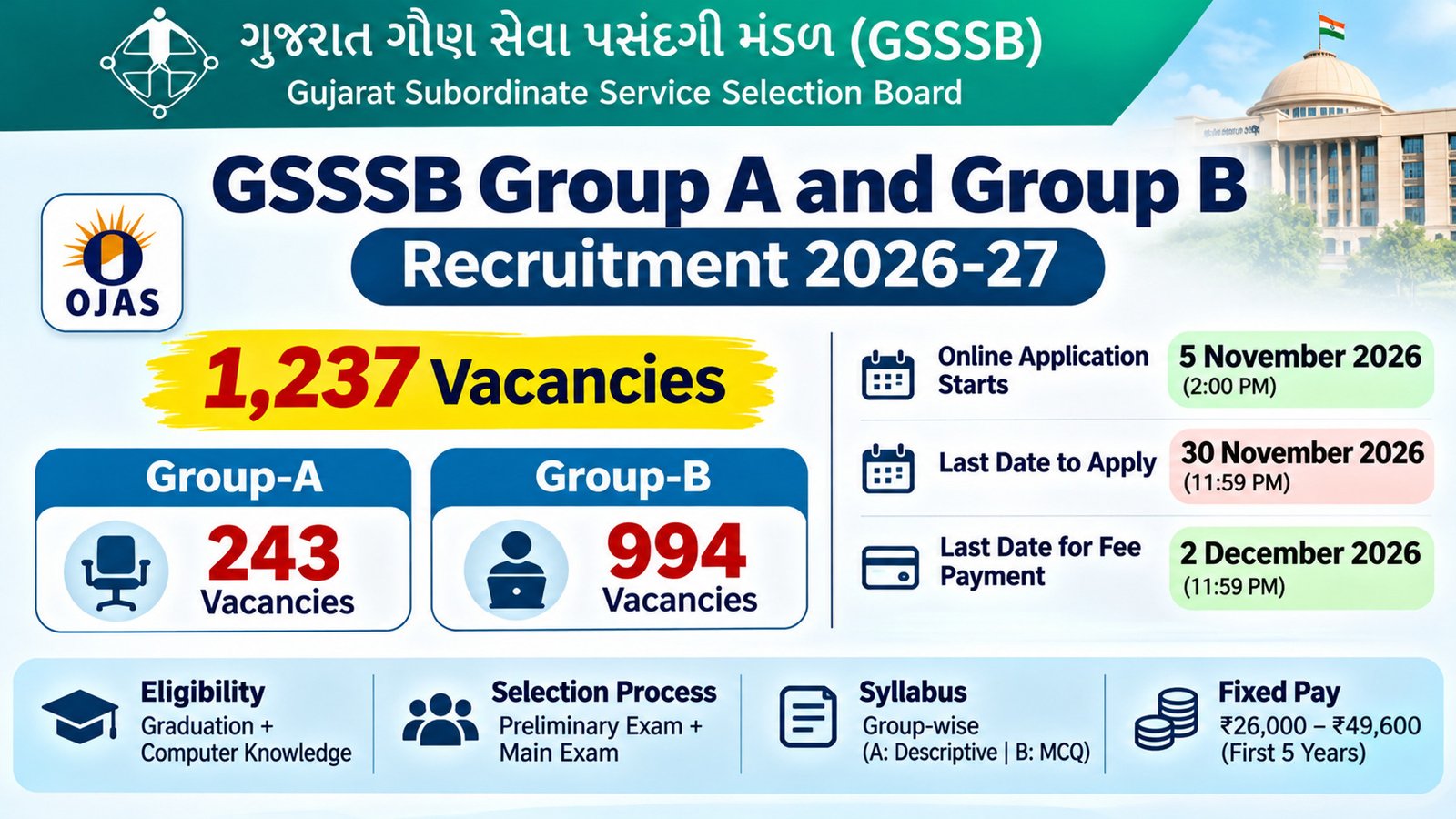
Gujarat Subordinate Service Selection Board (GSSSB) has announced 1,237 Class III vacancies under Group-A and Group-B through Advertisement No. 468/2026-27. The recruitment includes 243 Group-A posts and 994 Group-B Junior Clerk posts. Eligible graduates can apply online from 5 November to 30 November 2026 through the OJAS portal.
The selection process includes a common preliminary examination followed by separate main examinations for both groups. Candidates should check the post-wise vacancies, educational qualifications, age limit, fixed salary, examination pattern and syllabus before submitting their applications.
GSSSB Group A and Group B Recruitment 2026-27: Overview
The recruitment is being conducted for various Gujarat government departments under the Gujarat Subordinate Services Class III Combined Competitive Examination. Candidates can apply for the advertised positions after checking the eligibility requirements and relevant post-specific recruitment rules.
Here are the main details of the recruitment:
| Particulars | Details |
| Recruiting organisation | Gujarat Subordinate Service Selection Board (GSSSB) |
| Advertisement number | 468/2026-27 |
| Examination name | Group-A and Group-B Combined Competitive Examination |
| Recruitment category | Class III |
| Total vacancies | 1,237 |
| Group-A vacancies | 243 |
| Group-B vacancies | 994 |
| Application mode | Online |
| Application starting date | 5 November 2026 |
| Last date to apply | 30 November 2026 |
| Last date for fee payment | 2 December 2026 |
| Minimum age | 20 years |
| Maximum age | 35 years, before applicable relaxation |
| Selection process | Preliminary examination and main examination |
| Application portal | https://ojas.gujarat.gov.in/ |
The preliminary examination is common to both groups. Candidates who qualify will be considered for the respective Group-A or Group-B main examination according to separate merit lists.
GSSSB Group A and Group B Vacancy 2026: Post-Wise Details
The notification announces 1,237 vacancies across nine different posts. Group-A includes eight posts in different government departments, while all 994 Group-B vacancies are for Junior Clerk positions.
Group-A vacancy details
The Group-A recruitment includes administrative, registration, tribal development and social welfare positions.
| No. | Post name | Vacancies |
| 1 | Sub Registrar, Grade-1 | 6 |
| 2 | Sub Registrar, Grade-2 | 15 |
| 3 | Assistant Tribal Development Officer | 50 |
| 4 | Social Welfare Inspector | 89 |
| 5 | Office Superintendent | 7 |
| 6 | Office Assistant | 15 |
| 7 | Head Clerk | 10 |
| 8 | Senior Clerk | 51 |
| Total | 243 |
Social Welfare Inspector has the highest number of vacancies among the Group-A posts, with 89 positions. Assistant Tribal Development Officer has 50 vacancies, followed by Senior Clerk with 51.
Group-B vacancy details
| No. | Post name | Vacancies |
| 1 | Junior Clerk | 994 |
| Total | 994 |
All Group-B vacancies are for Junior Clerk positions across different government departments.
Group-A vs Group-B vacancy comparison
| Particulars | Group-A | Group-B |
| Number of posts | 8 | 1 |
| Total vacancies | 243 | 994 |
| Main examination | Descriptive | MCQ |
| Main examination marks | 350 | 200 |
The two groups have different main examination formats and separate final selection lists. Candidates should consider the examination structure and post requirements before deciding which group to prepare for.
GSSSB Recruitment 2026 Eligibility Criteria
Candidates must meet the educational qualification, computer knowledge, language and age requirements mentioned in the recruitment advertisement.
Educational qualification
The general educational qualification specified in the notification is:
- A bachelor’s degree from a university established or incorporated under a Central or State Act in India.
- A degree from an institution recognised as equivalent by the government.
- A degree from a deemed university recognised under Section 3 of the University Grants Commission Act, 1956.
- An equivalent qualification accepted by the government.
Candidates should check the applicable recruitment rules for their selected post because the final eligibility decision will consider all the relevant provisions.
Computer knowledge requirement
Applicants must have basic knowledge of computer applications as prescribed by the Gujarat government.
Candidates can demonstrate this knowledge through any of the following qualifications:
- A basic computer knowledge certificate from a training institution.
- A computer diploma or degree from a recognised university or institution.
- A recognised certificate course in computer applications.
- A degree or diploma course in which computer knowledge is included as a subject.
- Class 10 or Class 12 qualification with computer as a subject.
Can candidates apply without a computer certificate?
Yes. The notification allows candidates who do not currently possess the relevant computer knowledge certificate to apply. They must pass the prescribed basic computer knowledge examination and submit the required certificate to the appointing authority before appointment. Failure to do so can result in cancellation of their selection.
Gujarati and Hindi language knowledge
Candidates must have adequate knowledge of Gujarati or Hindi, or both languages.
This requirement should be considered before applying, particularly by candidates who have completed their education outside Gujarat.
Nationality
Candidates must be Indian citizens or meet the nationality requirements specified under Rule 7 of the Gujarat Civil Services Classification and Recruitment (General) Rules, 1967.
GSSSB Group A and Group B Age Limit 2026
The standard age limit for the recruitment is 20 to 35 years. The age will be calculated as of 30 November 2026, which is the final date for submitting the online application.
| Age requirement | Limit |
| Minimum age | 20 years |
| Maximum age | 35 years |
Category-wise age relaxation
The notification provides upper-age relaxation for eligible women, reserved-category candidates and persons with disabilities.
| Candidate category | Age relaxation |
| General category women | 5 years |
| Reserved category men | 5 years |
| Reserved category women | 10 years |
| General category men with eligible disability | 10 years |
| General category women with eligible disability | 15 years |
| Reserved category men with eligible disability | 15 years |
| Reserved category women with eligible disability | 20 years |
For the disability-related relaxations mentioned above, the maximum age limit is 45 years.
Age relaxation for ex-servicemen
Eligible ex-servicemen can receive relaxation equal to the period of military service, along with an additional three years, subject to the conditions in the advertisement.
Candidates must have the required ex-servicemen identification documents and discharge book.
Important: Reserved-category age relaxation and reservation benefits are subject to the Gujarat government rules and the candidate’s eligibility. Candidates applying against unreserved vacancies cannot automatically claim reserved-category age relaxation.
GSSSB Group A and Group B Salary 2026
Selected candidates will receive a fixed monthly salary during the first five years of service. The amount depends on the post.
The notification specifies the following fixed-pay amounts:
| Post name | Monthly fixed pay for first 5 years |
| Sub Registrar, Grade-1 | ₹49,600 |
| Sub Registrar, Grade-2 | ₹40,800 |
| Assistant Tribal Development Officer | ₹49,600 |
| Social Welfare Inspector | ₹40,800 |
| Office Superintendent | ₹49,600 |
| Office Assistant | ₹26,000 |
| Head Clerk | ₹40,800 |
| Senior Clerk | ₹26,000 |
| Junior Clerk | ₹26,000 |
Salary after five years
After completing five years, candidates may become eligible for regular appointment in the applicable government pay scale if their service is found satisfactory and they fulfil the conditions specified by the government.
The notification also refers to applicable government financial resolutions and other conditions governing fixed-pay appointments.
Candidates should understand that the figures in the table represent the initial fixed monthly remuneration. They should not be treated as the permanent pay scale or guaranteed in-hand salary after regular appointment.
GSSSB Group A and Group B Selection Process 2026
The recruitment follows a two-stage competitive examination.
- Preliminary examination
- Main examination
Both groups appear for the common preliminary examination. After the preliminary examination, separate qualifying lists are prepared for Group-A and Group-B.
Stage 1: Preliminary examination
The preliminary examination is conducted in MCQ format and carries 150 marks.
Candidates must meet the minimum qualifying requirements to become eligible for the main examination.
Stage 2: Main examination
The main examination differs according to the group:
- Group-A: Descriptive examination carrying 350 marks.
- Group-B: Objective-type MCQ examination carrying 200 marks.
How are candidates shortlisted for the main examination?
The notification specifies that candidates will be shortlisted separately for Group-A and Group-B based on their preliminary examination performance.
Up to seven times the category-wise vacancies will be considered for the respective main examination, based on merit.
The final selection lists will also be prepared separately for both groups, considering main examination marks, qualifying requirements and category-wise vacancies.
The notification states that no waiting list will be prepared for this combined recruitment.
GSSSB Preliminary Exam Pattern 2026
The preliminary examination is the same for Group-A and Group-B candidates. It tests English, Gujarati, general awareness, quantitative aptitude and reasoning.
Subject-wise marks distribution
| No. | Subject | Marks |
| 1 | English | 15 |
| 2 | Gujarati | 15 |
| 3 | General Awareness and Current Affairs | 30 |
| 4 | Quantitative Aptitude | 30 |
| 5 | Reasoning | 60 |
| Total | 150 |
Preliminary examination duration and marking scheme
| Particular | Details |
| Examination type | MCQ |
| Total questions | 150 |
| Total marks | 150 |
| Duration | 120 minutes |
| Marks per question | 1 |
| Negative marking | 0.25 marks per incorrect answer |
| Minimum qualifying standard | 40% |
Candidates with eligible disabilities will receive additional time of 20 minutes per hour, as specified in the notification.
Is the preliminary examination score considered for final selection?
No. The preliminary examination is conducted only as a screening test. Marks obtained in this examination will not be added to the final merit list.
Candidates should therefore focus on qualifying for the relevant main examination. The final selection will be based on the main examination and the prescribed qualifying requirements.
GSSSB Group A Mains Exam Pattern and Syllabus 2026
The Group-A main examination is descriptive and carries 350 marks. It contains three papers covering Gujarati, English and General Studies.
Group-A mains examination pattern
| Paper | Subject | Marks | Duration |
| Paper I | Gujarati Language Skills | 100 | 3 hours |
| Paper II | English Language Skills | 100 | 3 hours |
| Paper III | General Studies | 150 | 3 hours |
| Total | 350 |
Paper I: Gujarati language syllabus
The Gujarati paper tests writing ability, comprehension, grammar and translation.
The syllabus includes:
| Topic | Marks |
| Essay writing | 15 |
| Expansion of ideas | 10 |
| Precis writing | 10 |
| Prose review and comprehension | 10 |
| Statements for media | 5 |
| Letter writing | 5 |
| Discussion letter | 10 |
| Report writing | 10 |
| Translation from English to Gujarati | 10 |
| Gujarati grammar | 15 |
| Total | 100 |
Candidates should practise essays of approximately 250 words, short letters, reports and grammar exercises according to the prescribed question requirements.
Gujarati grammar includes:
- Idioms and their meanings.
- Proverbs.
- Samas and its identification.
- Chhand identification.
- Figures of speech.
- One-word substitutions.
- Spelling correction.
- Sentence correction.
- Sandhi.
- Sentence structure and transformation.
Paper II: English language syllabus
The English paper carries 100 marks and is descriptive.
| Topic | Marks |
| Essay writing | 15 |
| Formal letter writing | 10 |
| Report writing | 10 |
| Writing based on visual information | 10 |
| Formal speech | 5 |
| Precis writing | 5 |
| Reading comprehension | 20 |
| English grammar | 20 |
| Translation | 5 |
| Total | 100 |
The English grammar syllabus includes:
- Tenses.
- Active and passive voice.
- Direct and indirect speech.
- Sentence transformation.
- Articles and determiners.
- Prepositions.
- Phrasal verbs.
- Idiomatic expressions.
- Administrative vocabulary.
- Synonyms and antonyms.
- One-word substitutions.
- Connectives and linking words.
- Prefixes and suffixes.
- Homonyms and homophones.
Candidates should practise formal communication, comprehension and structured writing alongside grammar.
Paper III: General Studies syllabus
The General Studies paper carries 150 marks and covers Indian history, Gujarat’s cultural heritage, geography, science and technology, governance, economics and current affairs.
| Subject | Marks |
| History of India | 15 |
| Cultural Heritage | 15 |
| Geography | 15 |
| Science and Technology | 10 |
| Regional, National and International Events | 30 |
| Indian State System and Constitution | 20 |
| Public Administration and Governance | 20 |
| Discipline in Public Service | 10 |
| Indian Economy and Planning | 15 |
| Total | 150 |
Important topics under General Studies
1. History of India
- Indus Valley Civilisation.
- Vedic period.
- Jainism and Buddhism.
- Maurya and Gupta empires.
- Important dynasties of Gujarat.
- Arrival of Europeans in India.
- British rule and its expansion.
- Revolt of 1857.
- Indian freedom movement.
- Mahatma Gandhi and Sardar Patel.
- Post-independence India and the Mahagujarat movement.
2. Cultural Heritage
- Indian art, literature and architecture.
- Indian cinema and theatre.
- Arts and crafts of Gujarat.
- Gujarati theatre.
- Folk culture and oral traditions.
- Coastal and tribal culture of Gujarat.
3. Geography
- Physical geography of India and Gujarat.
- Rivers, climate and soil.
- Minerals and natural resources.
- Vegetation and water resources.
- Economic and demographic geography.
- Environmental problems.
- Sustainable development.
- Natural disasters and disaster management.
- Climate change and international conventions.
4. Science and Technology
- Science in everyday life.
- Indian contributions to science and technology.
- Information and Communication Technology.
- E-governance.
- Cybercrime and cybersecurity.
- India’s space programmes.
- Energy and nuclear policies.
- Technology in defence.
5. Regional, National and International Events
Candidates should prepare important developments and events at the Gujarat, national and international levels.
6. Indian State System and Constitution
- Features of the Indian Constitution.
- Union and State Government functions.
- Federal structure.
- Role of the Governor.
- Constitutional amendments.
- Parliament and State Legislatures.
- Judiciary and judicial review.
- Constitutional institutions.
- Fundamental rights and human rights.
7. Public Administration and Governance
- Nature and scope of public administration.
- Role of civil services in democracy.
- Government policies and implementation.
- Good governance.
- E-governance.
- Transparency and accountability.
- Right to Information.
- Public Service Act.
- Regulatory and constitutional institutions.
8. Discipline in Public Service
- Ethics in public services.
- Accountability and truthfulness.
- Attitude and human behaviour.
- Emotional intelligence.
- Human values.
- Anti-corruption systems.
- Lokpal and Lokayukta.
- Ethics-related case studies.
9. Indian Economy and Planning
- Indian economic development.
- Planning and NITI Aayog.
- Agriculture and industries.
- Banking and financial institutions.
- Monetary and fiscal policies.
- Public finance and taxation.
- Government expenditure and public debt.
- Rural development.
- Employment schemes.
- Gujarat’s economy and infrastructure.
The General Studies paper also specifies an approximate distribution of 56 questions across different marks categories:
| Marks per question | Number of questions | Total marks |
| 1 mark | 10 | 10 |
| 2 marks | 10 | 20 |
| 3 marks | 30 | 90 |
| 5 marks | 6 | 30 |
| Total | 56 | 150 |
This distribution helps candidates understand the expected answer lengths and the amount of writing required.
GSSSB Group B Mains Exam Pattern and Syllabus 2026
The Group-B main examination is an objective-type examination conducted through MCQ questions.
It carries 200 marks and has a duration of 120 minutes.
Group-B mains examination pattern
| Particular | Details |
| Examination type | MCQ |
| Total marks | 200 |
| Duration | 120 minutes |
| Minimum qualifying standard | 40% |
Group-B subject-wise syllabus
The notification specifies ten subject areas for the Group-B main examination.
| No. | Subject | Marks |
| 1 | Indian State System and Constitution | 20 |
| 2 | Indian Economy, State Economy and NITI Aayog | 20 |
| 3 | Public Administration and Governance | 20 |
| 4 | Discipline and Ethics in Public Service | 10 |
| 5 | Information on Various Government Schemes | 30 |
| 6 | Regional, National and International Important Events, including Current Affairs | 30 |
| 7 | History and Geography of Gujarat | 20 |
| 8 | Cultural Heritage of Gujarat (Art and Literature) | 10 |
| 9 | Gujarati and English | 20 |
| 10 | Science, Environment and Information Technology | 20 |
| Total | 200 |
Important areas to prepare for Group-B
Candidates should give attention to the following areas:
- Indian Constitution and government structure.
- Indian and Gujarat economy.
- NITI Aayog and economic development.
- Public administration and governance.
- Ethics in government services.
- Central and Gujarat government schemes.
- Current affairs at regional, national and international levels.
- Gujarat’s history and geography.
- Gujarati culture, art and literature.
- General science and environmental issues.
- Information technology.
- Gujarati and English language skills.
Government schemes and current affairs together account for 60 marks. Candidates preparing for Group-B should give these topics regular attention instead of concentrating only on static general knowledge.
GSSSB Group A and Group B Minimum Qualifying Marks
The notification specifies a minimum qualifying standard of 40% for both the preliminary and main examinations.
Candidates must satisfy the minimum qualifying requirement at each examination stage and in the applicable papers.
| Examination stage | Minimum qualifying standard |
| Preliminary examination | 40% |
| Group-A main examination | 40% in each paper |
| Group-B main examination | 40% |
The board will prepare separate selection lists for Group-A and Group-B based on the main examination results, qualifying requirements and category-wise vacancies.
Meeting the minimum qualifying marks does not automatically guarantee selection. Candidates must also secure a position in the relevant merit list.
GSSSB Group A and Group B Application Fee 2026
Candidates must pay the examination fee through the online payment facility available on OJAS.
The prescribed fee is:
| Candidate category | Examination fee |
| Unreserved category | ₹500 |
| Reserved categories and other eligible exempted categories | ₹400 |
The ₹400 fee category includes women candidates of all categories, SEBC, SC, ST, EWS, persons with disabilities and ex-servicemen, as specified in the notification.
Application fee payment conditions
- Payment must be completed online.
- Available payment methods include debit card, internet banking, UPI and wallets.
- Applicable transaction charges must be paid separately.
- The last date for fee payment is 2 December 2026, up to 11:59 PM.
- Candidates who appear for the examination will receive a refund of the examination fee.
- Candidates who do not appear for the examination will not receive a refund.
Candidates should download and save the payment receipt. If a payment receipt is not generated, the fee should not be assumed to have been successfully paid.
How to Apply Online for GSSSB Group A and Group B Recruitment 2026
Applications must be submitted online through the OJAS portal. Candidates who have not completed One Time Registration (OTR) must complete that process before filling out the recruitment application.
Step-by-step application process
Step 1: Visit the OJAS website
Open the Gujarat government’s online application portal.
Step 2: Complete One Time Registration
Candidates who are not registered should complete OTR using their required personal information.
Step 3: Open the recruitment application
Select the Online Application option, click Apply and choose GSSSB.
Step 4: Select Advertisement No. 468/2026-27
Find the Gujarat Subordinate Services Class III Group-A and Group-B recruitment advertisement.
Step 5: Enter personal details
Fill in the required personal information, including name, date of birth, category and other relevant details.
Step 6: Enter educational qualifications
Provide graduation and other required educational information.
Step 7: Upload photograph and signature
Upload the photograph and signature in the prescribed JPG format and file size.
Step 8: Review the application
Check all personal, educational and category-related information before confirmation.
Step 9: Confirm the application
Submit the application and save the generated Confirmation Number.
Step 10: Pay the examination fee
Complete the applicable online fee payment by 2 December 2026.
Step 11: Download the application
Print or save the completed application form and payment receipt for future reference.
Photograph and signature specifications
The notification provides specific requirements for uploaded photographs and signatures.
| Particular | Photograph | Signature |
| Format | JPG | JPG |
| Maximum file size | 15 KB | 15 KB |
| Height | 5 cm | 2.5 cm |
| Width | 3.6 cm | 7.5 cm |
The photograph should be recent, passport-sized and have a white background. Candidates should keep additional copies of the same photograph because it may be required during subsequent stages of recruitment.
Important application dates
| Recruitment activity | Date and time |
| Notification date | 3 November 2026 |
| Online application begins | 5 November 2026, 2:00 PM |
| Last date for online application | 30 November 2026, 11:59 PM |
| Last date for fee payment | 2 December 2026, 11:59 PM |
Candidates should complete the confirmation process before the application deadline. Completing OTR or saving an unconfirmed application does not count as successful submission.
Documents Required for GSSSB Recruitment 2026
Candidates should keep the relevant documents ready while filling out the application and for subsequent verification.
The documents may include:
- Graduation degree and marksheets.
- Date-of-birth proof.
- Computer knowledge certificate, where applicable.
- Caste certificate for eligible reserved-category candidates.
- SEBC non-creamy layer certificate, where applicable.
- EWS certificate in the prescribed format.
- Disability certificate, where applicable.
- Ex-servicemen identification card and discharge book, where applicable.
- Recent passport-size photograph.
- Scanned signature.
- Other certificates required under the applicable recruitment rules.
Category certificate requirements
Reserved-category candidates must pay particular attention to certificate validity and format.
SEBC candidates must provide the prescribed non-creamy layer certificate based on the applicable financial-year requirements. EWS candidates must submit the certificate in the prescribed format and within the specified validity period.
Candidates claiming age relaxation or reservation benefits should ensure that the certificate details entered in the online application match the original documents.
The board may cancel an application if the information submitted online does not match the documents produced during verification.
Important Instructions for GSSSB Applicants
Before submitting the application, candidates should check the following conditions:
- Read the complete Advertisement No. 468/2026-27 and the relevant post-specific recruitment rules.
- Check the educational qualification and age requirements carefully.
- Enter the correct category and personal details.
- Keep the registered mobile number and email address active throughout the recruitment process.
- Save the Application Number and Confirmation Number.
- Keep a copy of the completed application and fee receipt.
- Avoid submitting multiple applications. If multiple applications are submitted, only the last confirmed application is considered, subject to the notification’s fee-related conditions.
- Use the same photograph throughout the recruitment process.
- Submit valid supporting certificates whenever requested.
- Follow the instructions mentioned on the examination admit card.
Candidates should also follow the examination rules. The notification provides for action against unfair practices, impersonation, false documents and other examination-related misconduct under the applicable Gujarat public examination law.
Where to Check GSSSB Recruitment 2026 Official Updates
Candidates should rely on official government portals for recruitment-related information, including application instructions, examination schedules, admit cards and results.
The Gujarat Subordinate Service Selection Board’s official website publishes recruitment advertisements and examination-related announcements. Candidates can also check the original Advertisement No. 468/2026-27 and subsequent notices there.
Online application submission, application confirmation and examination fee payment are handled through the OJAS Gujarat portal.
The examination date and admit-card schedule should be checked through official announcements. Candidates should not rely on unverified dates circulated through social media or third-party websites.
| Official Notification | Click Here |
| Apply Online | Click Here |
Final Details About GSSSB Group A and Group B Recruitment 2026-27
GSSSB Advertisement No. 468/2026-27 announces 1,237 Class III vacancies, including 243 Group-A posts and 994 Group-B Junior Clerk posts. Graduates who meet the prescribed educational, age and other eligibility requirements can apply through OJAS.
The common preliminary examination carries 150 marks, while the main examination is different for each group. Group-A candidates must appear for a 350-mark descriptive examination, whereas Group-B candidates must take a 200-mark MCQ examination.
Candidates should check the complete notification, prepare according to their selected group’s syllabus and submit their applications before 30 November 2026. Keeping the required certificates and application details ready can also help avoid problems during document verification.